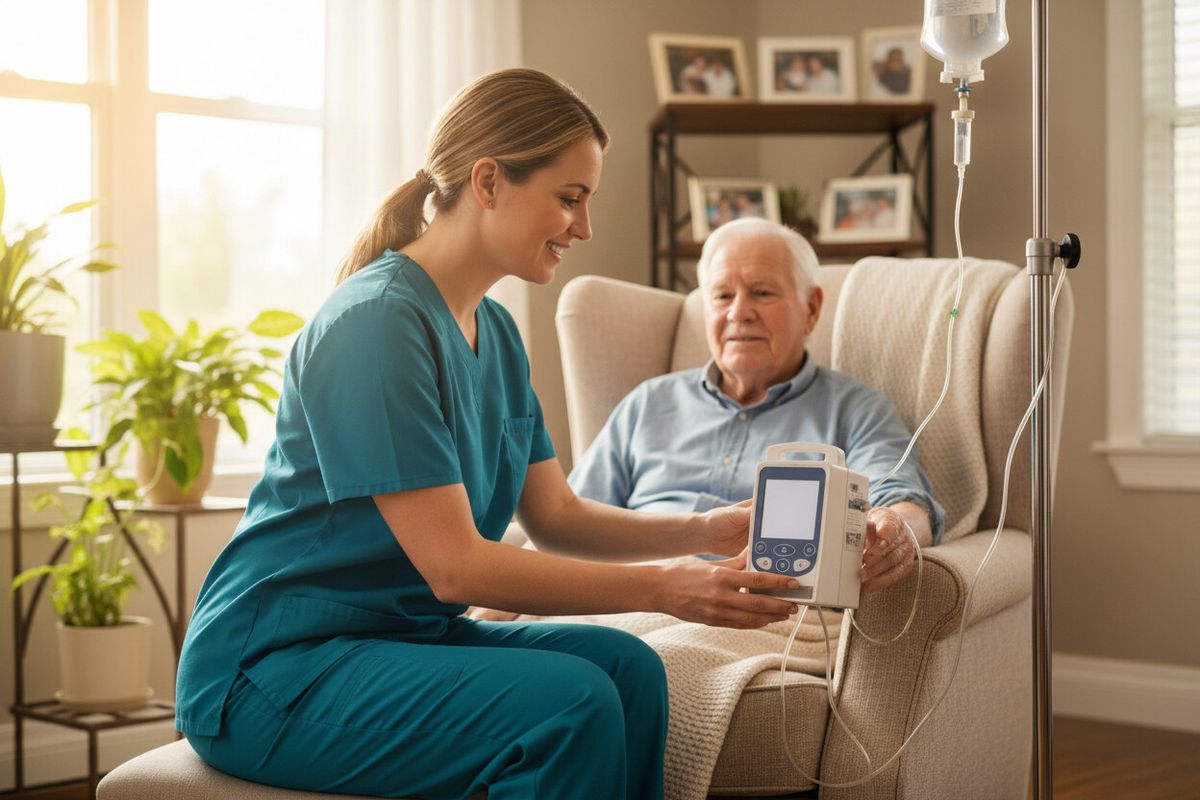
For patients who need repeated IV medications, the treatment itself is only part of the challenge. Traveling to a hospital or infusion center several times a week can be exhausting, especially after a hospital stay or when illness already makes mobility difficult. Families may also have to rearrange work, transportation, meals and caregiving around every appointment.
In-home IV infusion nursing changes that experience by bringing skilled clinical oversight to the patient rather than requiring the patient to repeatedly travel for treatment. The benefit is not simply convenience. A qualified nurse can help protect the IV access, administer or supervise therapy according to the prescribed plan, watch for changes in the patient's condition, educate the family, and communicate concerns back to the care team.
CMS recognizes nursing, patient education, training, and monitoring as important parts of home infusion therapy, not optional extras surrounding the medication itself.
Safety Starts With a Clear, Patient-Specific Infusion Plan
Successful home infusion begins before the medication is connected.
The nurse needs to understand the physician's orders, the prescribed medication, the vascular access being used, the patient's current condition, known allergies, other medications, and any monitoring requirements. The home setting also needs to support the therapy safely.
This matters because home infusion is not appropriate simply because a medication can be given intravenously. The patient must also be clinically suitable for treatment outside a hospital or infusion center.
For example, an older adult completing a course of IV antibiotics after discharge may be stable enough to recover at home but still need professional help managing a PICC line, recognizing complications, and keeping treatment on schedule. Another patient receiving a specialty medication may need closer observation because of the possibility of an infusion-related reaction.
A good home infusion plan considers those differences rather than treating every infusion the same.
A Nurse Helps Protect the IV Line, Where Many Complications Can Begin
An IV catheter creates direct access to the bloodstream, which makes proper line care especially important. Home infusion nurses bring a structured clinical routine to catheter handling instead of leaving patients or relatives to figure out line care on their own.
Aseptic Technique Reduces Unnecessary Exposure
Before accessing, dressing, or otherwise handling an intravascular catheter, careful hand hygiene and aseptic technique are fundamental infection-prevention measures. CDC guidance specifically recommends hand hygiene before and after accessing or dressing an intravascular catheter and maintaining aseptic technique during catheter care.
During a home visit, the nurse can follow the appropriate catheter-care procedure, assess the dressing and surrounding skin and make sure supplies are being handled correctly.
The nurse can also reinforce practical habits between visits, such as keeping the catheter area protected and avoiding unnecessary manipulation of the line.
Small Changes at the Site Can Be Identified Early
Patients may not know whether slight redness, soreness, swelling, leaking, or a loose dressing is important. An infusion nurse knows what requires closer assessment.
CDC guidance recommends regularly assessing catheter sites and replacing dressings when they become damp, loose, or visibly soiled. Patients should also report new discomfort or changes around the catheter site.
Recognizing a developing problem early gives the clinical team an opportunity to respond before it becomes more serious.
Medication Administration Has an Extra Layer of Clinical Oversight
Home infusion therapy involves more than attaching tubing to an IV line.
Depending on the treatment plan, the nurse may need to confirm the medication and physician order, assess the patient before administration, evaluate the vascular access, use the prescribed infusion equipment and observe how the patient responds.
This structured process is particularly valuable when treatment involves infusion pumps, multiple medications, changing doses or therapies that require specific administration procedures.
Professional oversight also provides another opportunity to catch issues such as an unexpected medication change, confusion about the schedule, damaged supplies, a missed dose, or a discrepancy between what the patient has at home and what was prescribed.
The goal is straightforward: the therapy that was ordered should be the therapy that is actually delivered.
Monitoring Continues Before, During, and After the Infusion
One of the biggest advantages of in-home infusion nursing is having someone assess the patient rather than focusing only on the IV bag.
A nurse may evaluate the patient's general condition before treatment and watch for symptoms during the infusion. Depending on the prescribed therapy and care plan, monitoring may include vital signs, medication tolerance, the condition of the vascular access, and other treatment-specific observations.
Some medication reactions appear quickly. Others develop after a patient has already received several doses. IDSA guidelines for outpatient IV antibiotic therapy emphasizes the need for systems that monitor both vascular-access complications and medication-related adverse events.
That ongoing clinical attention makes home infusion very different from simply dropping off medications and supplies.
Care Coordination Helps Prevent Treatment Gaps
Home infusion commonly involves several people and organizations: the prescribing physician, infusion pharmacy, nursing team, patient, family caregiver, and sometimes hospital discharge staff or facility personnel.
Without coordination, even a well-designed treatment plan can become fragmented.
Questions can quickly arise. Was the dose changed? Should therapy continue after a new symptom appears? When is the next dressing change? Does the pharmacy need a new order? Has the physician been told about a problem with the line?
The nurse becomes an important clinical connection between the patient and the rest of the treatment team.
CMS similarly describes home infusion as a coordinated process involving patients, physicians, discharge planners, health plans, infusion pharmacies, and home-care providers.
My Heart Care Services follows this coordinated approach through its in-home IV infusion therapy service, providing nurse-led oversight while working with prescribing physicians, infusion pharmacies, clinical teams, and facility staff when applicable. Its services include support for IV antibiotics, hydration therapy, prescribed specialty medications, chronic-condition-related infusions, and post-discharge infusion therapy.
Comfort Comes From Removing the Burden Around Treatment
The clinical benefits of nursing oversight are important, but comfort is another major reason families consider home infusion.
Repeated trips to a medical facility can consume a large portion of the day. A patient may need to get dressed, arrange transportation, travel across town, wait for treatment, receive the infusion, and travel home—all while recovering from surgery, infection, or another health problem.
At home, treatment can take place in a familiar environment. The patient can often remain near family, rest in their own space, and avoid unnecessary disruption to the rest of the day.
For people with limited mobility, fatigue, memory concerns, or complex caregiving needs, eliminating repeated transportation can make an especially meaningful difference.
Comfort does not replace clinical safety. The advantage of professional home infusion nursing is that patients can gain more comfort without giving up structured clinical oversight when home treatment is appropriate.
Patients Can Keep More Independence Without Carrying the Entire Responsibility
Home treatment does not necessarily mean the patient or family must become the primary medical professional.
The level of participation depends on the therapy and care plan. Some treatments may be administered directly by a visiting nurse. In other situations, appropriately selected patients or caregivers may be trained to perform certain tasks between nursing visits.
IDSA guidance supports home administration of outpatient IV antibiotics for properly selected patients or caregivers when appropriate training and an effective monitoring system are in place.
Clear education should help patients and caregivers understand:
- how to protect and care for the IV access between visits;
- which symptoms or catheter-site changes should be reported;
- what to do if an infusion cannot be completed as planned;
- how prescribed medications and supplies should be handled; and
- whom to contact when a clinical question or unexpected problem occurs.
This approach gives patients more control over daily life while keeping professional support within reach.
Who May Benefit Most From In-Home IV Infusion Nursing?
Home infusion can be particularly useful when the treatment is clinically appropriate for the home setting but repeated facility visits create unnecessary difficulty.
Common situations include:
- patients completing prescribed IV antibiotics after hospital discharge;
- people who require ongoing or recurring infusion treatments;
- patients with mobility or transportation challenges;
- individuals receiving prescribed hydration or specialty medications;
- patients whose treatment requires regular nursing assessment or line care; and
- families who need better coordination between physicians, pharmacies, facilities, and home care.
My Heart Care Services specifically supports patients at home as well as individuals living in assisted living and memory care settings across the Dallas–Fort Worth area.
What a High-Quality Home Infusion Nursing Visit Should Accomplish
A home infusion visit should feel organized rather than improvised.
Depending on the prescribed treatment, the nurse may review the current order, assess how the patient has been feeling since the previous dose, inspect the vascular access, perform required catheter care, administer or supervise the medication, monitor the patient's response, document findings, and communicate relevant changes to the treatment team.
Just as importantly, the visit gives patients and family members a chance to ask questions that might otherwise wait until the next physician appointment.
That regular clinical contact can make treatment feel less uncertain. Instead of wondering whether a new symptom, pump issue, or catheter change is significant, the patient has a defined route for getting the concern evaluated.
Home Infusion Is Not the Right Setting for Every Patient
Home treatment should never be chosen solely because it is easier.
Some patients need the resources and immediate medical support of a hospital or infusion center. Suitability depends on the prescribed medication, the patient's stability, vascular access, potential reactions, monitoring needs, home environment, and ability of the patient or caregiver to participate safely in the care plan.
Even the first dose of certain medications may require specific supervision. IDSA guidance, for example, notes that a first dose of a new outpatient IV antimicrobial may be given at home only when appropriate and under supervision of healthcare personnel qualified and equipped to respond to a serious allergic reaction.
The safest approach is therefore not "home whenever possible." It is the right setting for the right patient with the right level of professional support.
Conclusion
In-home IV infusion nursing can remove much of the disruption associated with repeated hospital or infusion-center visits, but convenience is only part of its value.
The real advantage comes from combining treatment at home with professional assessment, careful vascular-access management, medication oversight, patient education, monitoring, and communication with the wider healthcare team.
When those pieces work together, patients can receive necessary IV therapy in a setting that feels more familiar and manageable without treating home care as a shortcut around clinical safeguards.
As more care moves beyond traditional healthcare facilities, the strongest home infusion programs will be the ones that preserve this balance: greater comfort and independence for the patient, supported by disciplined nursing oversight and coordinated medical care.
Frequently Asked Questions
Is IV infusion therapy at home safe?
It can be safe for appropriately selected patients when treatment is prescribed by the medical team and supported by proper catheter care, medication procedures, patient education, and clinical monitoring. Not every medication or patient is appropriate for home infusion.
Can a nurse administer IV antibiotics at home?
Yes. Prescribed IV antibiotic therapy is commonly provided in home-care settings. Depending on the care plan, a nurse may administer the medication directly or provide nursing assessment, catheter care, training, and monitoring around patient or caregiver administration.
Does a family member have to manage the IV?
Not necessarily. The amount of family involvement depends on the prescribed therapy and service model. When patients or caregivers perform infusion-related tasks themselves, they should receive appropriate training and have a reliable system for clinical support and monitoring.
What happens if a patient reacts to an infusion at home?
The response depends on the symptoms and medication involved. A trained nurse can assess the situation, follow the prescribed clinical protocol, communicate with the treating provider, and obtain emergency assistance when required. Patients should be given clear instructions about who to contact if symptoms develop outside a nursing visit.
Does insurance cover in-home IV infusion nursing?
Coverage varies by medication, insurer, benefit plan, supplier and clinical circumstances. Medicare has a home infusion therapy benefit for qualifying services associated with certain covered drugs and biologicals, while private insurance requirements differ. Patients should verify coverage with their insurer and infusion provider before treatment begins.
Educational notice: This material is for general information only. It does not replace medical advice, a diagnosis, a physician’s order, or emergency care.