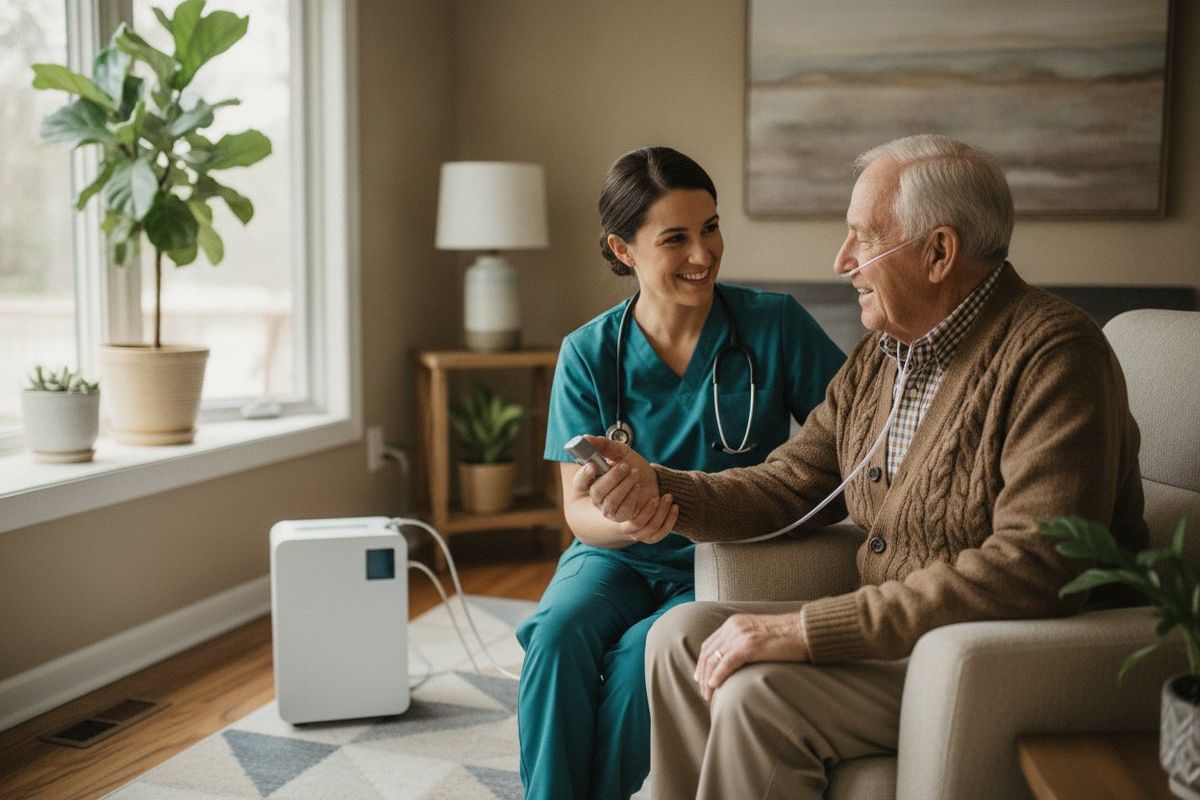
Living with COPD at home can be manageable when symptoms are stable. The challenge is that breathing difficulties can change quickly. A patient who normally moves comfortably around the house may suddenly become more short of breath, start wheezing more, produce different mucus or struggle with routine activities.
That is where home nursing can make a meaningful difference.
For people who need more clinical support than family members or traditional caregivers can safely provide, private duty nursing at home can bring skilled monitoring, medication support, respiratory condition management and communication with the patient's medical team into the home. My Heart Care Services provides this care through an RN-guided model designed for patients with complex or changing health needs.
What Does a Home Nurse Do for a COPD Patient?
Home nursing for COPD is not simply about having someone nearby. The nurse's role is to help carry out the physician-directed care plan while watching closely for changes that may require medical attention.
For planned clinical support, explore our private nursing services at home and discuss the assessed needs with our team.
Depending on the patient's condition and physician orders, nursing support may include:
- Monitoring breathing patterns, respiratory symptoms, oxygen saturation when ordered, and changes in the patient's overall condition
- Helping the patient follow prescribed medication, inhaler, nebulizer and oxygen routines
- Watching for possible medication problems or difficulty following a complicated medication schedule
- Reinforcing correct use of respiratory equipment according to the patient's prescribed care plan
- Identifying early signs of a COPD flare-up
- Communicating important changes to physicians, home health providers, specialists, or family members
- Supporting a safer transition home after hospitalization
- Helping the patient pace daily activities without unnecessary physical strain
My Heart Care Services includes respiratory conditions among the chronic health needs supported through its chronic condition care at home, particularly when families are dealing with recurring setbacks, complex treatment plans, or gaps between provider visits.
Catching COPD Flare-Ups Before They Become More Serious
One of the most valuable parts of consistent nursing care is knowing what is normal for a particular patient.
COPD symptoms vary considerably from person to person. A nurse who regularly sees the same patient can become familiar with that person's usual breathing pattern, activity tolerance, cough, mucus production, sleep habits and general energy level. That makes unusual changes easier to recognize.
A COPD flare-up may involve increasing shortness of breath, more wheezing, worsening cough, or changes in the amount or color of mucus. Symptoms can become serious enough to require hospital treatment so patients should have a physician-directed COPD action plan explaining what to do when symptoms worsen.
Home nursing adds another layer of observation. For example, suppose an older adult normally walks from the bedroom to the kitchen with one brief rest but suddenly needs several stops and takes much longer to recover. A nurse can document that change, check other relevant symptoms or measurements included in the care plan, and communicate concerns rather than simply assuming the patient is having a bad day.
That type of early response is especially valuable for someone with repeated exacerbations or recent hospitalizations.
Making COPD Medication Routines Easier to Follow
COPD treatment may involve maintenance inhalers, rescue medicines, nebulized medications, pills, and treatments for other chronic conditions. The difficulty is not always remembering that medicine needs to be taken. Patients must also know which medication is used when and how to use the delivery device correctly.
The American Lung Association emphasizes taking the right medication at the right time using the right technique. It also recommends reviewing medication schedules and inhaler technique with healthcare professionals because COPD treatment can become complicated when several medicines are involved.
A home nurse can help follow the prescribed medication plan, observe whether the patient is having difficulty using an inhaler or nebulizer, and identify questions that should be brought back to the physician or pharmacist.
This becomes particularly useful when a patient has recently returned from the hospital with changed prescriptions. Instead of expecting the patient or family to immediately understand a new routine, skilled nursing support can help bring structure to the transition.
Supporting Safe Oxygen Use at Home
Some COPD patients are prescribed supplemental oxygen. When they are, oxygen needs to be treated as prescribed medical therapy, not something that should be increased or decreased independently because the patient feels more short of breath.
MedlinePlus advises patients not to change their oxygen flow without consulting their healthcare provider. Home oxygen also requires practical safety precautions, including keeping equipment away from flames and heat sources and maintaining an appropriate backup supply when continuous oxygen is required.
The American Lung Association also notes that oxygen supports combustion even though oxygen itself is not flammable. Tubing can create a fall hazard, and households should have plans for equipment or power interruptions when oxygen is continuously needed.
For a COPD patient receiving nursing care at home, the nurse can reinforce the prescribed routine, observe equipment use, and identify safety concerns in the actual environment where the patient lives.
That last point matters. Instructions that seem simple in a hospital room can become more complicated when oxygen tubing stretches across a hallway, the patient needs to shower, or the concentrator depends on household electricity.
Helping COPD Patients Conserve Energy Without Becoming Completely Inactive
Breathlessness often changes how people perform everyday tasks. Showering, dressing, preparing food, climbing stairs or simply walking between rooms may require much more effort than they once did.
The goal at home is not to encourage complete inactivity. Excessive inactivity can contribute to further loss of strength and independence. Instead, the patient's healthcare team may recommend strategies that make necessary activities less demanding.
Practical approaches can include sitting while completing certain tasks, keeping frequently used items within easy reach, moving at a steady pace, taking planned rest periods, and getting assistance with physically demanding activities. Pulmonary rehabilitation may also be recommended because it combines supervised exercise, breathing strategies and education for people with chronic lung disease.
A home nurse can help translate these recommendations into the patient's normal routine. For example, if morning bathing consistently leaves a patient exhausted for several hours, the care plan may need better pacing, assistance, or discussion with the medical team.
Home Nursing After a COPD Hospitalization
The period immediately after a COPD-related hospitalization deserves particular attention. Patients may come home with new medications, revised oxygen instructions, follow-up appointments, reduced stamina, or a recovery plan involving several healthcare providers. At the same time, family members may suddenly find themselves responsible for managing care they have never handled before.
Post-discharge care combined with skilled nursing can help create continuity between hospital instructions and what actually happens at home.
A nurse can review the discharge plan, support prescribed medication routines, observe recovery, and help ensure that concerning changes reach the appropriate healthcare professional. My Heart Care Services specifically includes post-discharge monitoring and coordination with discharge plans within its private duty nursing model.
For families, that continuity can be particularly valuable when the patient looks well enough to come home but still has limited respiratory reserve.
Why Care Coordination Matters With COPD
COPD rarely exists in isolation, particularly in older adults. A patient may also be seeing a primary care physician, pulmonologist, cardiologist, physical therapist, home health clinician, or other specialists.
Problems arise when everyone has part of the information but nobody sees the entire picture.
This is why care coordination services can be an important part of home COPD support. My Heart Care Services' model includes communication among physicians, home health agencies, facilities, families, and the nursing team rather than treating each home visit as an isolated event.
Consider a patient whose breathing worsens after a medication change. The family may not know whether to contact the pulmonologist, primary physician, pharmacy, or another provider. Coordinated nursing care creates a clearer path for documenting what has changed and getting the relevant information to the right professional.
When Should Families Consider Home Nursing for COPD?
Not every person with COPD requires private duty nursing. A patient with stable symptoms who independently manages medications and daily activities may need little additional clinical support.
Home nursing becomes more worth considering when:
- COPD symptoms or flare-ups are becoming harder for the family to manage.
- The patient has recently been hospitalized or repeatedly visits the emergency department.
- Medication, nebulizer, or prescribed oxygen routines have become complicated.
- Family caregivers are uncomfortable assessing changes in breathing.
- The patient has several chronic conditions requiring coordinated care.
- There are long gaps between professional healthcare visits while the patient's condition still requires close attention.
- Increasing weakness or breathlessness is making daily life less safe.
My Heart Care Services uses an RN assessment to understand the patient's needs and develop a personalized care plan before services begin. Its care model can combine nursing, in-home support, and coordination as those needs change.
Know When COPD Symptoms Need Urgent Medical Attention
Home nursing is valuable, but it does not replace emergency care. Patients and families should follow the individual's COPD action plan and healthcare provider's instructions. Severe or rapidly worsening breathing problems require prompt medical attention.
Warning signs can include severe difficulty catching the breath, inability to speak normally because of breathlessness, blue or purple lips or fingertips, new confusion or unusual drowsiness, chest discomfort, or breathing that continues to worsen despite following the prescribed treatment plan. MedlinePlus advises emergency evaluation for severe breathing difficulty and medical contact when symptoms continue to worsen.
A good home care plan should make these escalation instructions clear before an emergency happens.
Home Nursing Can Make COPD Care More Manageable
Successful COPD care at home depends on consistency. The patient needs medications used correctly, oxygen handled safely when prescribed, symptoms recognized early, daily activities paced appropriately, and important changes communicated to the medical team. When these responsibilities become too difficult for the patient or family to manage alone, skilled home nursing can provide the clinical oversight that ordinary household assistance cannot.
For families in the Dallas–Fort Worth area, My Heart Care Services provides private duty nursing for patients who need ongoing clinical support at home. Care is guided by nurses and can work alongside physicians, home health providers, and family members as the patient's needs evolve.
The goal is not simply to keep a person with COPD inside the home. It is to make home a safer, better-organized place to manage a condition that can change from one day to the next.
FAQs
Can a home nurse care for someone with COPD?
Yes. Depending on the patient's needs and physician-directed care plan, skilled home nursing can include respiratory-condition monitoring, medication support, prescribed oxygen oversight, symptom observation, and communication with healthcare providers.
Can home nursing help prevent COPD hospitalizations?
Home nursing cannot guarantee that hospitalization will be avoided. However, consistent monitoring may help identify worsening symptoms earlier and improve follow-through with prescribed treatment and escalation plans.
Can a home nurse adjust a COPD patient's oxygen level?
Oxygen should be used according to the prescribing healthcare provider's instructions. Patients and caregivers should not independently change oxygen flow unless their medical team has specifically instructed them how and when to do so.
Is private duty nursing useful after a COPD hospital stay?
It can be especially helpful when the patient comes home with new medications, oxygen instructions, decreased strength, complicated follow-up care or a higher risk of another setback.
How do I know whether my family member needs COPD home nursing?
Consider a professional assessment when breathing symptoms are becoming less predictable, treatment routines are difficult to manage, hospital visits are becoming more frequent, or family caregivers no longer feel comfortable managing the patient's clinical needs alone.
Related reading: Home Care Nurses: What They Do for Families at Home
Considering nursing care at home?
Tell our team what nursing care is needed, where care will take place, and the requested schedule. We can discuss service fit, assessment requirements, availability, and costs.
Explore Nursing Services · Discuss Nursing Needs · Call 469-492-6966
Educational notice: This material is for general information only. It does not replace medical advice, a diagnosis, a physician’s order, or emergency care.