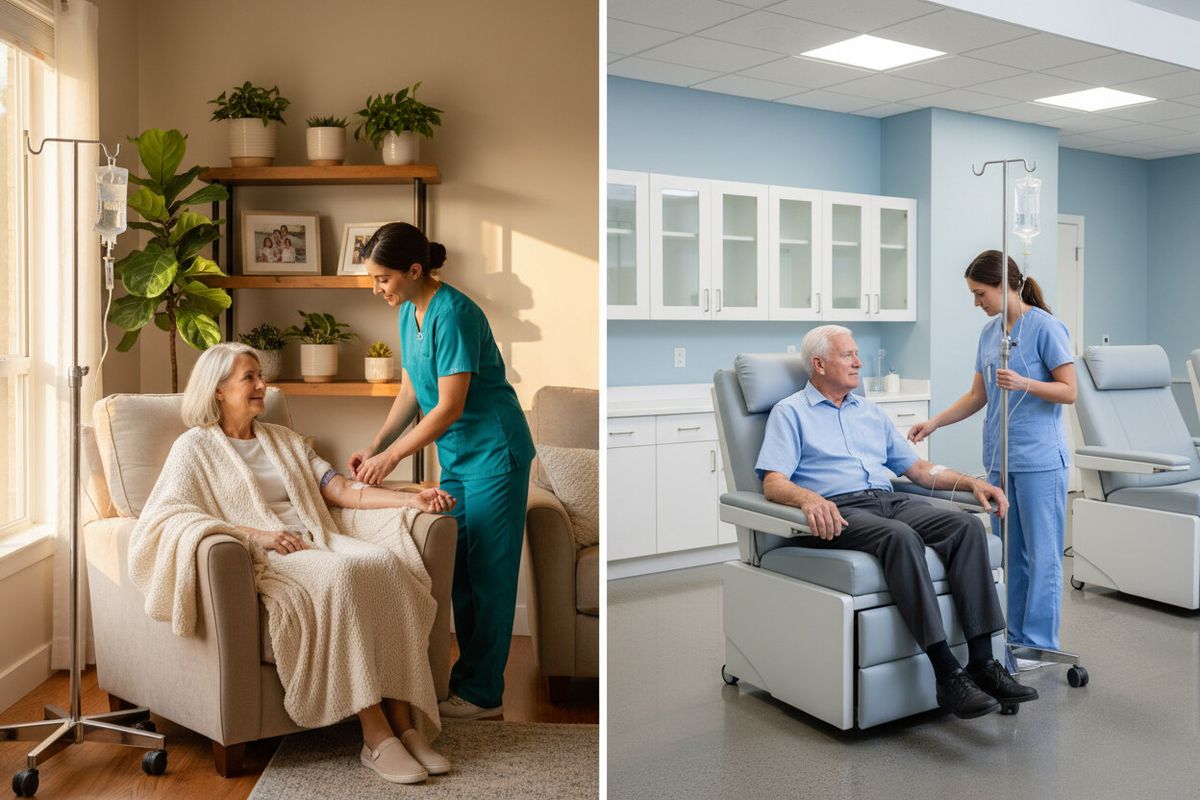
When your doctor prescribes ongoing IV therapy, the next question is often practical: Do you need to travel to an infusion center for every treatment, or can you safely receive the infusion at home?
That decision can affect far more than convenience. The treatment setting determines how much travel you have to manage, who administers the medication, how supplies are handled, how your IV line is monitored, and what you may need to do between nursing visits.
There is no universal “better” choice. Home IV infusion can make treatment far less disruptive for an appropriate patient, particularly when therapy continues for days or weeks. An infusion center, however, may be the better setting when treatment requires more direct observation, the patient is uncomfortable managing any part of the process at home, or the home environment cannot reliably support the therapy.
The goal is to choose the safest practical setting for your specific medication, condition, support system, and insurance coverage.
Home IV Infusion vs. an Infusion Center: The Key Differences
Both settings are designed to deliver prescribed IV medications, but the day-to-day experience is quite different.
| Consideration | Home IV Infusion | Infusion Center |
|---|---|---|
| Treatment location | Your home or other approved residential setting | Clinic, physician office, or dedicated infusion facility |
| Travel | Usually reduced | Required for scheduled treatments |
| Medication administration | May be provided by a nurse or, for some therapies, by a trained patient/caregiver | Healthcare professional administers treatment onsite |
| Supplies | Medication, tubing, pumps, and related supplies must be coordinated for the home | Facility manages most treatment supplies |
| Monitoring | Planned nursing and clinical monitoring, with communication between providers | In-person healthcare staff are available during the visit |
| Home responsibilities | May include medication storage, line protection, equipment management, and reporting concerns | Fewer treatment-related responsibilities between visits |
| Best suited for | Clinically appropriate patients who can safely receive therapy outside a facility | Patients whose treatment or personal circumstances favor direct onsite care |
Safe home infusion is not simply a matter of having an IV and medication delivered to the house. U.S. guidance emphasizes patient selection, appropriate vascular-access management, monitoring for complications, and reliable communication with the treatment team.
When Home IV Infusion May Be the Better Choice
Frequent treatments make repeated travel difficult
The value of home infusion becomes especially noticeable when therapy is frequent.
Imagine someone discharged from the hospital with several weeks of IV antibiotics. Driving to an infusion center every day may require arranging transportation, getting in and out of a vehicle while recovering, waiting for treatment, and then traveling home again.
Receiving appropriate treatment at home can remove much of that disruption while allowing the prescribed therapy to continue.
My Heart Care Services provides IV infusion therapy at home for appropriate patients across the Dallas–Fort Worth area, including support for IV antibiotics, hydration therapy, prescribed specialty medications, chronic-condition-related infusions, and post-discharge infusion therapy.
The patient is medically stable enough for home treatment
Convenience should never determine the treatment location by itself.
Before home infusion begins, the care team needs to determine whether the patient's condition, medication, IV access, monitoring requirements, and overall treatment plan are appropriate for home care.
For outpatient IV antibiotic therapy, for example, clinical guidance specifically emphasizes the importance of a patient or caregiver who can follow instructions and communicate with the treatment team, along with a reliable system for monitoring vascular-access problems and medication-related adverse events.
The home can support the treatment safely
Home infusion also depends on the environment.
Depending on the medication and delivery system, patients may need an appropriate place for medication and supply storage, reliable refrigeration, clean space for handling supplies, and a way to contact the clinical team quickly if something changes.
Home infusion may be a strong option when:
- The prescribing clinician approves the home setting.
- The medication and administration method are suitable for home use.
- The patient or caregiver can follow the required instructions, or nursing support is arranged.
- Medications and supplies can be stored appropriately.
- IV access can be cared for safely.
- There is a clear plan for monitoring, laboratory work when required, and reporting problems.
These details matter because a successful home infusion program depends on much more than administering the medication itself.
When an Infusion Center May Be the Better Choice
An infusion center removes many of the logistical responsibilities that come with receiving treatment at home. Medication preparation, administration, and observation take place in a clinical environment with healthcare professionals present during the appointment.
The treatment requires more direct observation
Some medications or patient circumstances call for closer onsite monitoring. In other cases, the prescribing team may want a treatment given in a facility because of the medication protocol, the patient's medical history, or concern about how the patient may respond.
Even a first dose that is considered appropriate for home administration requires proper clinical supervision when there is a potential for a serious reaction.
The patient does not want to manage infusion-related tasks
Not every patient wants medication boxes, infusion equipment, tubing, pumps, and line-care responsibilities at home.
That preference is legitimate.
An infusion center may be more comfortable for someone who wants healthcare professionals to handle the entire treatment process during every visit rather than taking responsibility for any part of infusion care between visits.
The home setting is not suitable
An infusion center may also make more sense when:
- Safe medication storage cannot be maintained.
- The patient has difficulty understanding or following treatment instructions.
- A reliable caregiver is needed but unavailable.
- Mobility, vision, dexterity, or cognitive issues make home responsibilities difficult.
- The clinical team determines that closer in-person observation is appropriate.
Age alone does not automatically rule out home therapy. The more useful question is whether the individual can safely participate in the treatment plan or has adequate caregiver and nursing support.
The Biggest Lifestyle Difference Is What Happens Between Infusions
People often compare home infusion and infusion centers only by looking at travel. The more meaningful difference may be who manages the details between treatments.
At an infusion center, much of the treatment process stays inside the facility. You arrive, receive the prescribed treatment, complete any required observation, and leave.
At home, care extends beyond the actual infusion. Medication and supplies may need to arrive on schedule. The vascular-access device needs appropriate care. Symptoms and treatment response must be monitored. Laboratory testing may need to be coordinated. Questions may involve the prescriber, infusion pharmacy, nursing team, or another healthcare provider.
CMS describes home infusion as a coordinated process that can involve patients, physicians, infusion pharmacies, nurses, health plans, and other care organizations. A current plan of care and communication among those parties are important parts of safe treatment.
For patients already dealing with several doctors or services, professional care coordination across providers can therefore be just as important as the infusion itself.
Consider Your Recovery Stage, Not Just the Infusion Schedule
The right treatment location can also change over time.
Someone immediately returning home after surgery or hospitalization may have weakness, new medications, wound care needs, mobility limitations, and multiple follow-up appointments in addition to IV therapy. Repeated trips to an infusion center may add substantial strain during this stage of recovery.
In that situation, home infusion may fit naturally into a broader post-discharge care plan that helps organize medications, recovery monitoring, appointments, and communication with providers.
For another patient, the opposite may be true. A person who is independent, lives close to an infusion center, receives treatment infrequently, and prefers having healthcare staff handle each treatment may find clinic-based infusion simpler.
The decision should fit the whole patient, not just the prescription.
Insurance Coverage Can Change Which Option Makes Sense
Always verify benefits before assuming that home infusion or an infusion center will cost less.
Coverage depends on the medication, administration method, insurance plan, provider network, pharmacy, supplies, and site of care.
For eligible Medicare beneficiaries, Medicare Part B covers certain home infusion equipment and supplies as durable medical equipment and certain professional services needed to administer qualifying IV or subcutaneous medications at home. Medicare states that beneficiaries typically pay 20% of the Medicare-approved amount for covered home infusion services and covered equipment and supplies, with applicable deductible requirements. Coverage does not mean every infusion drug or every home infusion arrangement automatically qualifies.
Before choosing a treatment location, ask the insurer and infusion provider whether the prescribed medication is covered at home, whether prior authorization is required, which pharmacy and nursing providers are in network, how supplies are billed, and what your expected out-of-pocket responsibility will be.
Do the same calculation for an infusion center. Comparing the complete treatment episode is more useful than comparing one copay.
How to Decide Which Setting Is Right for You
Ask whether the medication is appropriate for home infusion
Start with the prescribing clinician. Some therapies transition easily to home care, while others may require a particular clinical environment or monitoring protocol.
Clarify who will administer the medication
“Home infusion” does not always mean the patient administers the treatment independently.
Depending on the therapy and care model, a nurse may administer or supervise treatment, while some appropriately selected patients or caregivers can be trained to perform certain infusions themselves with ongoing clinical monitoring.
Understand who is responsible for your IV line and monitoring
Ask who handles dressing changes, line assessments, laboratory work, medication changes, and calls about possible complications.
A clear answer to these questions is a good sign that the home infusion plan is truly coordinated.
If the patient has broader clinical needs beyond intermittent infusion visits, private duty nursing at home may also be relevant.
Think realistically about the home environment
Consider whether the patient can manage the treatment routine on good days and difficult days.
Fatigue, pain, limited mobility, cognitive changes, poor vision, or caregiver availability can all affect what is practical. The best plan is one the patient and family can follow consistently rather than one that only works under ideal circumstances.
Confirm coverage before changing the site of care
Clinical approval should come first, but financial verification should happen before treatment begins whenever possible. Ask for an explanation of benefits or estimated patient responsibility for both options.
A Practical Example: The Same Medication, Two Different Patients
Consider two people who both need a multiweek course of IV antibiotics.
The first patient has recently left the hospital, uses a walker, lives with a family member, has a suitable home environment, and has an infusion team coordinating medication delivery, line care, and monitoring. Daily travel would be physically exhausting. If the prescriber determines the therapy is appropriate for home treatment, home infusion may offer a much more manageable recovery routine.
The second patient lives alone, has difficulty handling medical equipment, does not have reliable support, and feels uncomfortable managing an IV outside a clinical facility. Even if the medication technically can be given at home, an infusion center may provide a better fit.
That is why the decision should never be reduced to "home is more convenient" or “a clinic is safer.” Suitability depends on the patient, the therapy, the support system, and the care plan working together.
Home IV Infusion Support in Dallas–Fort Worth
For patients who are appropriate candidates for home treatment, My Heart Care Services provides nurse-led IV infusion support in homes as well as assisted living and memory care settings throughout the Dallas–Fort Worth area.
Its home infusion model includes coordination with prescribing physicians, infusion pharmacies, clinical teams, and facility staff when applicable. The service supports treatments including IV antibiotics, hydration therapy, prescribed specialty medications, ongoing infusions, and post-discharge IV therapy.
If you have already received an infusion order but are unsure whether receiving treatment at home is realistic, you can speak with a My Heart Care Services care coordinator about the services available and discuss the next steps with your prescribing healthcare team.
Conclusion
Home IV infusion can be an excellent option when the therapy is suitable for home use, the patient is clinically appropriate, monitoring is organized, and medication, nursing, supplies, and provider communication are properly coordinated. It can be particularly valuable for patients who would otherwise face frequent and difficult trips to an infusion center.
An infusion center may be the better choice when more direct observation is needed, the home cannot support treatment safely, or the patient simply feels more comfortable having professionals handle every infusion onsite.
The strongest decision is therefore not based on convenience alone. It balances clinical safety, treatment complexity, patient capability, home support, lifestyle, and insurance coverage.
As healthcare continues to expand beyond traditional hospital and clinic settings, more patients will have meaningful choices about where treatment happens. The most useful approach will remain the same: choose the site of care that provides the right level of clinical support with the least unnecessary disruption to the patient's life.
FAQs
Is home IV infusion as safe as receiving treatment at an infusion center?
Home IV infusion can be appropriate for carefully selected patients when the medication is suitable for home use and there is proper nursing, training, line care, monitoring, and provider communication. It is not appropriate for every patient or every medication.
Can IV antibiotics be given at home?
Yes. Many patients can receive outpatient IV antibiotic therapy at home when their prescribing healthcare team determines that home administration is clinically appropriate and suitable monitoring is arranged.
Do I need a nurse for every home IV infusion?
Not always. Some treatments are administered by nurses, while appropriately selected patients or caregivers may be trained to administer certain therapies themselves. The required level of nursing involvement depends on the medication, patient, provider orders, and care plan.
Does Medicare cover home infusion therapy?
Medicare Part B covers certain home infusion services, equipment and supplies for qualifying therapies. Coverage depends on specific eligibility and treatment requirements, so patients should verify benefits before beginning home infusion.
What should I ask my doctor before choosing home infusion?
Ask whether your medication is suitable for home treatment, what monitoring is required, who will manage your IV access, who to contact if a problem occurs and whether your insurance covers the complete home infusion arrangement.
Educational notice: This material is for general information only. It does not replace medical advice, a diagnosis, a physician’s order, or emergency care.